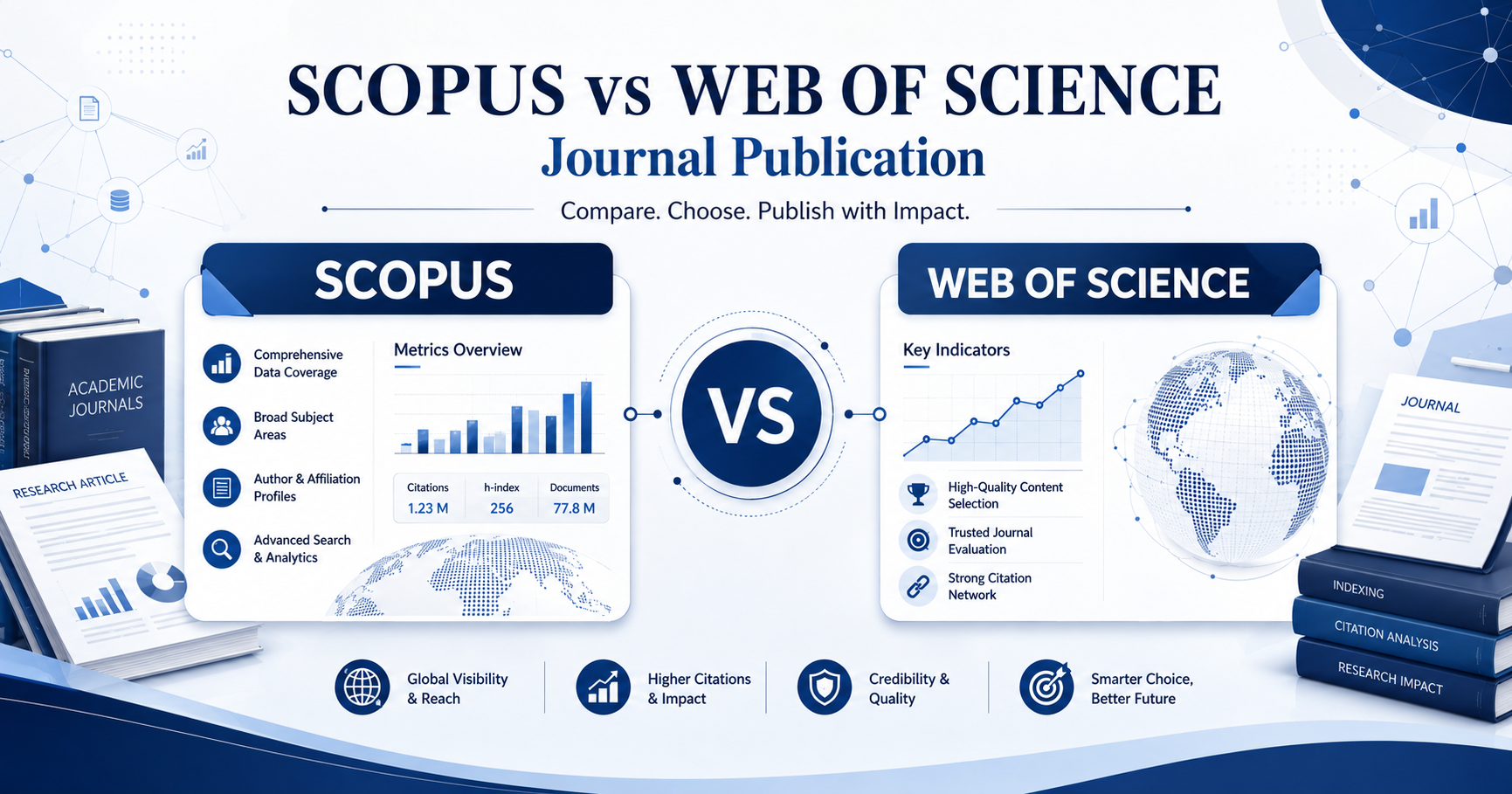
For researchers planning their next academic journal publication, one question often comes up: Should you target a Scopus-indexed journal or a Web of Science-indexed journal?
As universities, funding agencies and research institutions continue to focus on the quality of journals and their indexing status, the conversation is gaining significance for Scopus Journal Publication and Web of Science publication. Although both platforms are highly regarded globally, they are not the same, and being aware of the differences can assist researchers in deciding where to publish.
You are not the only one who has tried to find a solution for the query "scopus vs web of science". Every year, thousands of researchers make comparisons between the two platforms when deciding on the journal to submit to.
Let's discuss the major differences that every researcher needs to know in 2026.
Why Journal Indexing Matters in Research Publishing?
The work of publishing a research is just the first step. A study has to be visible, discoverable and accessible to the wider academic community to make an impact.
This is where Journal indexing databases play a crucial role.
Indexing databases are useful for organizing scholarly literature, facilitating research to locate similar studies, keep track of citations, and assess the quality of journals.
Researchers tend to pay more attention to publications in databases that are trusted.
In addition, the publication in indexed journals is also an important criterion for many universities and academic institutions in promotions, funding, and degree requirements.
Understanding Scopus Journal Publication
Scopus is one of the world's biggest citation and abstracting databases. It includes thousands of journals from a range of disciplines, including the arts and humanities, business, engineering, medicine, and social sciences, that are indexed by Scopus.
Researchers like Scopus Journal Publication because of its wide coverage. The journals that are present in the database are from a large number of different countries and different fields of study, which provides more opportunities for their researchers.
Scopus also offers detailed citation analysis tools which enable researchers to track the impact and reach of their published work.
Since its wide range of scope, Scopus has become a popular choice for researchers who want to make their research more visible worldwide.
Understanding the Web of Science Database
The web of science database is another highly respected platform used by researchers worldwide. It has been a cornerstone of scholarly publishing for decades and is widely recognized for its rigorous journal evaluation standards.
Web of Science is more selective than Scopus which is more general. The journals are subject to a detailed reviewing process before being added to the database.
Consequently, many of these web of Science-indexed journals are considered as influential journals in the field.
When researchers are interested in publishing in journals that have a good reputation and high citation rates, they tend to go for Web of Science journals.
Scopus vs Web of Science: The Core Difference
When comparing Scopus vs. Web of Science, the most significant difference lies in their approach to journal coverage.
Scopus typically covers more journals in different scientific fields and from various geographic locations. It could be useful for researchers with interdisciplinary interests or new research interests.
Web of Science is more selective in its approach, and places a strong emphasis on journal quality, editorial standards and the influence of citations.
Both are not necessarily good. Rather they are used for different purposes and have different publication goals.
Journal Selection Standards
Both databases pre-screen journals for inclusion in the database, but have different screening criteria.
Scopus takes into account:
- Peer-review quality
- Editorial policies
- Publication ethics
- International diversity
- Citation performance
Web of Science Places Strong Emphasis On:
- Editorial rigor
- Publishing consistency
- Research influence
- Citation impact
- Academic reputation
This is because some journals are included in Scopus but not in Web of Science and vice versa.
The Role of Peer-Reviewed Journals
Researchers should definitely prefer to publish their research work in reputable peer-reviewed journals, irrespective of the indexing database.
Peer review is still one of the most crucial quality control tools in academic publishing. In this process, manuscript is assessed by independent experts before publication, which helps in ensuring accuracy, originality and scientific value of the research.
Scopus and Web of Science primarily include journals that are published and adhere to the standards of recognized peer review, adding to their credibility in the academic community.
CiteScore vs Impact Factor: Understanding the Metrics
Journal metrics is one aspect that frequently confuses researchers.
You'll often see comparisons of citescore to impact factor in your journal review.
CiteScore is a Scopus related metric. It represents the mean number of citations documents in a journal have received in a given time period.
However, Web of Science's Impact Factor is one of the most popular ways to measure journal influence, and is not the same thing.
These are two metrics that attempt to measure journal performance, but are calculated in different ways and rely on two different data sources.
Scientists and researchers should not use only one criterion and prioritize the journal based on its impact on their field and audience.
Impact Factor vs SJR: Which Metric Matters More?
Another popular comparison is impact factor vs sjr.
SJR, or SCImago Journal Rank, is a Scopus-based metric that considers not only the number of citations a journal receives but also the influence of the citing journals.
The primary concern of Impact Factor is definitely citation frequency in a particular period.
Both indicators have their merits but reflect different measures of journal influence. The decision of which one to use will depend on the context and aims of the researcher.
The best publication tactics are to consider a variety of indicators, not just one.
Web of Science vs Scopus Journals: Which Should You Choose?
It is a question that will vary depending on the research goals.
The journals that are indexed in Scopus may have more opportunities for wider publication and more international visibility, if you are looking for more.
Web of science indexed journals might be appropriate if you want to publish in journals that have a high level of citations and influence.
Fortunately, many highly regarded journals are found in both databases. By publishing in such journals, one can get the benefits of both systems, and also get maximum visibility and recognition.
Researchers need not only to compare Web of Science and Scopus journals for the database rivalry but also to choose a journal that is suitable for their research topic, readers, and career goals.
Common Misconceptions Researchers Should Avoid
One of the main confusions is that Web of Science is always better than Scopus. In fact, both databases are well-respected and of high standard by the universities around the world.
The other myth is that the journals published in Scopus are easier to be published in them. The acceptance of a manuscript is not just about the website on which it is indexed but about the quality of the manuscript, editorial standards of the journal and the peer-review process.
Avoid using journal metrics as a sole selection criteria for researchers. A journal that aligns to your research subject area may be more useful in the long term, and may not be ranked as high as you'd like.
Final Thoughts
The debate between scopus and web of science is sure to endure for years, but the bottom line is that both services are important in the modern era of scholarly publication.
Scopus provides comprehensive coverage, worldwide reach, and a variety of publication options. Web of science database offers a very selective list of journals that are highly valued for their academic impact and quality of research.
Regardless of whether you select Scopus Journal Publication or any of the top web of science indexed journals, the number one rule is to publish quality research in a journal that caters to your field and audience.
Successful research publishing is not about “gambling” with which database you use in 2026. It's about intelligent choices in publishing to ensure maximum visibility, credibility and influence of your published work in the long term.
Frequently Asked Questions
What is the difference between Scopus and Web of Science?
Scopus generally offers broader journal coverage, while Web of Science is more selective and emphasizes rigorous journal evaluation and citation impact.
Is Scopus better than Web of Science?
Neither is universally better. The right choice depends on your research field, institutional requirements, target audience, and publication goals.
Can a journal be indexed in both Scopus and Web of Science?
Yes. Some journals are indexed in both Scopus and Web of Science, provided they meet the respective databases’ evaluation and inclusion criteria.
Which is better for publication, Scopus or Web of Science?
Both can be strong choices. Researchers should prioritize a reputable, peer-reviewed journal that matches their research scope and meets their institution’s requirements.
How do I check if a journal is indexed in Scopus or Web of Science?
Check the journal directly in the official Scopus or Web of Science journal lists rather than relying only on claims made on the journal’s website.
What is the difference between CiteScore and Impact Factor?
CiteScore is a Scopus-based journal metric, while Impact Factor is a Web of Science/Clarivate metric. They use different databases and calculation methods, so their values should not be compared directly.
Mikky Publication Experts
Mikky Publication Editorial
Published August 7, 2026
Updated August 7, 2026