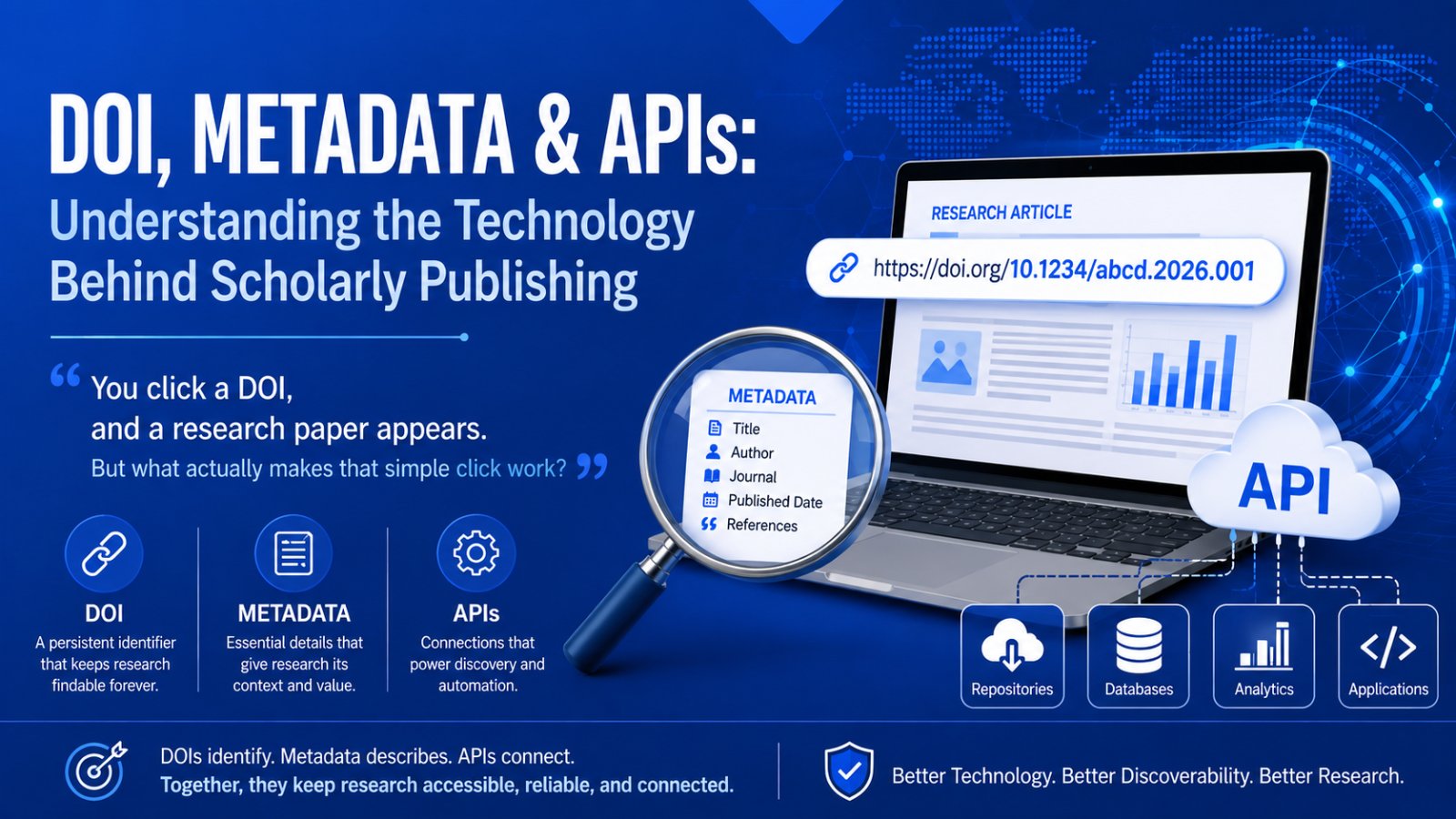
"You click a DOI, and a research paper appears. But what actually makes that simple click work?"
Every research paper you find online depends on a quiet system working in the background. You click a link, and the paper opens—even if it was published years ago or has since moved to a different journal or publisher.
Behind this click lie three vital components: DOIs, metadata, and APIs. Each one serves its own purpose; however, their combination is key to success. They allow scientists to easily access papers, cite them properly, and process data in computer programs.
This article looks at how these three pieces work, where the system can still fall short, and why common standards are important for keeping scholarly research connected and easy to discover.
What is DOI, really?
What is DOI? You might come across a DOI while reading a research paper but it is quite difficult to realize what the DOI really is. DOI is short form for Digital Object Identifier. It is an identifier assigned to scholarly works, including but not limited to a research paper, dataset, book chapter, or conference paper.
This can be understood as an everlasting name for any research work. An ordinary web address would change once the journal switches its website, platform or even publisher. A DOI will be an exception.
It might look something like this: 10.1186/s13321-015-0081-7. This DOI, once entered after doi.org, will lead you to the current webpage of that research item.
Here is one thing that is often confusing for most people. A DOI will not usually lead you to the actual PDF. It will simply lead you to the landing page maintained by the publisher/repository from which you could read/download the paper.
So, a DOI gives you a stable route to the work. It does not necessarily mean that the full text will always be freely available.
DOI is something that has existed since the late 1990s. The fundamental concept of it remains rather simple, although the surrounding infrastructure of DOI has evolved quite a bit since then. With registration agencies, metadata standards, and application programming interfaces, the flow of information can now occur across different platforms automatically without checking every document individually.
DOI in a research paper's lifecycle
DOI in research paper publishing usually becomes relevant around the time an article is accepted and prepared for publication. The identifier is registered by the publisher at the registration agency. Crossref is popular for the registration of journal articles, whereas DataCite is popular for registering datasets.
At this point, it's not only about registration of a unique identifier. Other details regarding the publication are provided to the registration agency. These may include title, authors, journal name, date of publication, affiliations, references, and funders, among others.
The DOI itself is only an identifier. What makes it useful is the information connected to it.
Another reason this step is essential is that errors could make their way into the record permanently.
Any errors in author names, an absence of an ORCID ID, or a lack of recording a funder would get transferred to other databases and stay there for a long time. While corrections are possible later, it is better to do this during registration of the paper.
 Figure 1 — The basic DOI registration flow behind almost every published article.
DOI vs URL vs Handle
| Identifier | Persistent? | Points directly to content? | Typical use |
|---|---|---|---|
| Plain URL | No — breaks when a page moves | Yes, until it breaks | General web pages |
| DOI | Yes | No — redirects to a landing page | Journal articles, datasets |
| Handle | Yes | Can be configured to point to specific files | Institutional repositories |
The difference becomes clearer with a simple example.
Imagine a journal changes its website. The old URL for an article may no longer work. Anyone using that link could end up with an error page.
The DOI is different. The publisher can update where the DOI leads, while keeping the identifier unchanged. This is one reason DOIs are so useful in academic publishing.
A DOI provides a standard citation format for researchers in referring to the paper. This makes it possible for the researcher to reference the same identifier regardless of where the paper is relocated.
A Handle works in a similar way because it is also designed as a persistent identifier. However, the systems using Handles can configure them for different types of digital objects and files.
Why DOI metadata matters more than the DOI itself
A DOI by itself does not tell you much. DOI metadata is what gives the identifier useful context.
It could have the title of the paper, author names, ORCID identifiers, publishing date, journal details, funder information, license details, and references.
An easy analogy of this would be a library book. In this case, the DOI number is similar to the ID number of the book. The other details surrounding it provide the title, author, publisher, date, and subject.
This information matters because most research discovery now happens through systems that read records automatically. Search engines, library databases, citations, and other research tools are built around structured data.
Article metadata associated with an article during publication could become one of the key elements of its digital footprint.
The issue is that supporting material does not always receive the same level of attention. An article can have datasets, graphs, code, or additional files that are hidden within a PDF file.
That makes them harder to find and reuse.
Good research paper metadata should allow a system to answer basic questions without opening the entire article.
- Who wrote the paper?
- Where was it published?
- When was it published?
- Who supported the research?
- What work does it cite?
- Is there a license for reuse?
When these details are present and accurate, the paper becomes much easier to connect with other research.
A quick look at what a metadata record actually contains
A typical DOI record can contain much more than the identifier itself.
This includes the title of the paper, authors' names, affiliations, journal name, volume number, issue number, date of publication, publisher information, sponsors, licensing and many others.
Other records might also include additional information like datasets or earlier versions of the paper.
The interesting thing is that all this information can be read by software without having to open the article at all.
For instance, a database would have to find out who wrote a particular paper and the year it was published.
Instead of browsing the journal website, it could ask for that information through the record.
That saves time and makes large-scale research discovery possible.
It also explains why missing information can cause problems. If a publisher does not provide an ORCID iD, funder identifier, or reference list, another system cannot simply guess it with certainty.
Crossref metadata and how DOI registration works
Crossref metadata is widely used in many parts of the scholarly publishing industry. Hundreds of millions of research articles have been registered in Crossref by thousands of its members worldwide.
For journal publishers, Crossref is one of the main organisations used to register DOIs for scholarly articles.
The basic process is fairly straightforward. Information related to the article is prepared by the publisher and submitted to Crossref. This record is processed and stored, and the DOI becomes a part of the article's persistent digital identity.
When the record is made available, other systems can get information from it.
 Figure 2 — Growth of Crossref-registered DOI and metadata records, 2002–2026. Source: Crossref public statistics and community updates.
Crossref's collection has grown enormously over the years. It reached millions of records in its early years and now contains well over 100 million scholarly records.
That growth tells us something about modern academic publishing. More research is being published, and more of it is being represented in machine-readable systems.
But a large number of records does not automatically mean that every record is complete.
One paper may have detailed author information, references, funding, and license information. Another may contain only basic bibliographic details.
So the quality of the record still matters.
Metadata API, Crossref API, and DOI API — what is the actual difference?
These terms can sound confusing because they are often used together.
A metadata API is a term used to describe any service allowing computer applications to get information about digital resources. This may include such information as titles, authors, dates of publication, publishing houses, etc.
The Crossref API is the service provided by Crossref itself to facilitate searching and accessing scholarly content. Users or developers can conduct searches using the DOI number, title, authors or any other information related to the content.
A DOI API, on the other hand, is a broader term. It can refer to an API or service that helps software work with DOI-related information. Different organisations can provide such services, so the exact information available depends on the system being used.
| Term | What it actually refers to |
|---|---|
| Metadata API | A general term for an API that provides descriptive information such as titles, authors, and dates |
| Crossref API | Crossref's specific REST API for finding and retrieving structured scholarly records |
| DOI API | A broader term for APIs used to look up or work with DOI-related information |
An academic publishing API may combine several of these functions. It will help the system to recognize the research entry, extract the details, and correlate with other information.
This is particularly helpful when you have to deal with thousands or millions of data entries.
But an API cannot make up for information that has not been provided. If a publisher submits incomplete information, the API will generally return an incomplete record.
Where scholarly publishing metadata still has gaps
Even with huge amounts of information available online, scholarly publishing metadata still has some noticeable gaps.
Supplementary material is one of them.
Research papers can come with datasets, experimental results, images, code, tables, and other supporting files. In some fields, these files can be much larger than the main paper.
Yet they are often grouped into one supplementary PDF instead of being described individually.
For a reader, this may be inconvenient. For a computer, it is an even bigger problem.
A person can open a PDF and look for a particular table. A computer needs structured information to know that the table exists and where it can be found.
Some newer repositories are improving this situation by describing individual files and datasets separately. This allows a system to identify a specific resource instead of treating everything as one large package.
Standards such as OAI-ORE and DataCite's metadata framework can also help describe relationships between a main research item and its supporting resources.
The long-term goal is simple: make research materials easier for both people and machines to find.
Best practices for authors and publishers
A few small steps can make a big difference to the life of a research paper.
- Authors should provide their ORCID iD during submission. This helps connect their work correctly across different journals and research systems.
- Publishers should submit complete reference lists as structured information. This makes it easier for other systems to identify citation relationships.
- Dataset depositors should provide information about individual files when the repository supports it.
- Publishers should check important metadata before publication and correct errors when they are discovered.
- Authors should also check their names, affiliations, funding details, and ORCID information during the publication process.
These may seem like administrative details, but they affect how research is found and connected later.
What this means in practice
For researchers, accurate DOI metadata can make a paper easier to discover, cite, and connect with other research.
It can also help link a publication with an author's ORCID profile or the organisation that funded the work.
For publishers, the work does not end when the article goes online. The information surrounding the article also needs attention.
A beautifully designed journal website does not automatically create good metadata. The information needs to be entered, checked, and maintained properly.
For developers building research tools, there is another important point. An API is only as useful as the records behind it.
If a publisher provides a complete record, software can do much more with it. If important fields are missing, the same software has fewer options.
This is why metadata should be treated as part of the publication process rather than as a technical task to deal with later.
The bottom line
DOIs, metadata, and APIs complement each other.
The DOI helps to provide an identity for the research object. The metadata provides the description of the object. APIs enable computers to access this information.
DOIs can function for decades, but their effectiveness highly relies on the quality of information associated with DOIs.
Authors should ensure the accuracy of the information provided. Publishers should submit full information and fix mistakes. Developers should be aware of what can be obtained from the available information.
Good DOI metadata helps turn a simple identifier into a useful research record.
It might be a small technical point, but it makes a difference when it comes to research being discovered, cited, referenced, and reused.
Frequently Asked Questions
What is DOI in simple terms?
DOI is a digital identifier used for a research paper or data set or any academic literature. It helps in locating the article when the URL of the document is changed.
How is a DOI different from a regular URL?
A DOI will always stay intact even when the location of the research item changes. A regular URL may break if the web page changes its address or website location.
What is DOI metadata, exactly?
These are the details associated with the DOI such as title, authors, dates, funders, citations and other details related to the research object.
What does the Crossref API actually return?
It provides structured information about scholarly publications such as title, author, journal details, date of publication, citations, licensing details, funding sources, etc.
Who is responsible for DOI registration?
DOI registration is done by publishers, repositories, and other organizations through Crossref and DataCite, among others, based on the nature of the scholarly material.
Mikky Publication Experts
Mikky Publication Editorial
Published September 4, 2026
Updated October 19, 2026