“Is publishing in a DOAJ-indexed journal enough for NMC faculty promotion?”
Not by itself. DOAJ indexing is important, but it is only one part of the complete publication eligibility check.
For medical faculty, choosing a journal is no longer simply about finding a place that will publish a paper. The NMC publication requirements also make it important to understand the journal's indexing, publication type, authorship and other applicable conditions.
The current framework is the Medical Institutions (Qualifications of Faculty) Regulations, 2025, which came into force on June 30, 2025. NMC's current regulations page also lists these regulations and related FAQs.
It should be noted that the 2025 regulations refer to the Directory of Open Access Journals (DOAJ) as one of the databases used for the definition of a research publication.
So, where exactly does DOAJ fit into the NMC framework?
What Is DOAJ?
The Directory of Open Access Journals (DOAJ) is a global directory of open-access scholarly journals.
DOAJ doesn’t just include all the journals that claim to be “open access.” DOAJ’s criteria involve issues like open access, editorial information, peer review, licensing, copyright, author fees, etc.
For example, DOAJ requires journals to have a clear peer-review process. Its current guidance says that articles must pass through a quality-control system before publication, with the peer-review process clearly explained on the journal website.
This makes the DOAJ-indexed journals helpful to researchers that are looking for recognized open access publications.
But there is an important distinction.
DOAJ indexing does not automatically mean NMC promotion eligibility
Being indexed in DOAJ is a solution to the database component. It does not imply that each article in DOAJ will meet each criterion for a medical faculty member.
This is precisely what your research material shows – indexing in databases needs to be looked at in terms of publication types, authors, time and other such criteria.
What Do the Current NMC Publication Requirements Say?
The 2025 NMC regulations define a research publication as only certain types of publications, including:
- Original papers
- Meta-analysis
- Systematic reviews
- Case series
The regulations state that these must be published in journals indexed in specified databases, including MEDLINE, PubMed Central, Science Citation Index, Science Citation Index Expanded, Embase, Scopus and DOAJ.
This is an important part of the current NMC publication criteria.
However, researchers should not stop at the database name. The NMC regulations also prescribe qualifications, experience, research and other requirements for different faculty positions.
That means the practical question is not simply:
“Is this journal indexed in DOAJ?”
Instead, ask:
“Does this journal and my particular publication meet all the applicable NMC requirements for my faculty position?”
NMC-Specified Databases at a Glance
| Database | General relevance |
|---|---|
| MEDLINE | Biomedical and medical literature |
| PubMed Central | Full-text biomedical and life-science literature |
| Science Citation Index | Citation indexing |
| Science Citation Index Expanded | Wider scientific citation coverage |
| Embase | Biomedical and pharmacological literature |
| Scopus | Multidisciplinary research and citation database |
| DOAJ | Open-access scholarly journal directory |
Therefore, when researchers search for NMC indexed journals, DOAJ is one of the databases they should consider.
Are DOAJ Journals “NMC Approved Journals”?
This is one of the most common areas of confusion.
Researchers may come across terms such as:
- NMC approved journals
- NMC indexed journals
- NMC accepted journals
- NMC-recognised journals
However, the above terms should not be construed to imply that NMC has individually approved each journal found in the respective databases mentioned above.
The existing scheme recognizes the databases where eligible journals can be listed. The journal should also satisfy all other requirements.
So:
DOAJ indexing ≠ blanket NMC approval
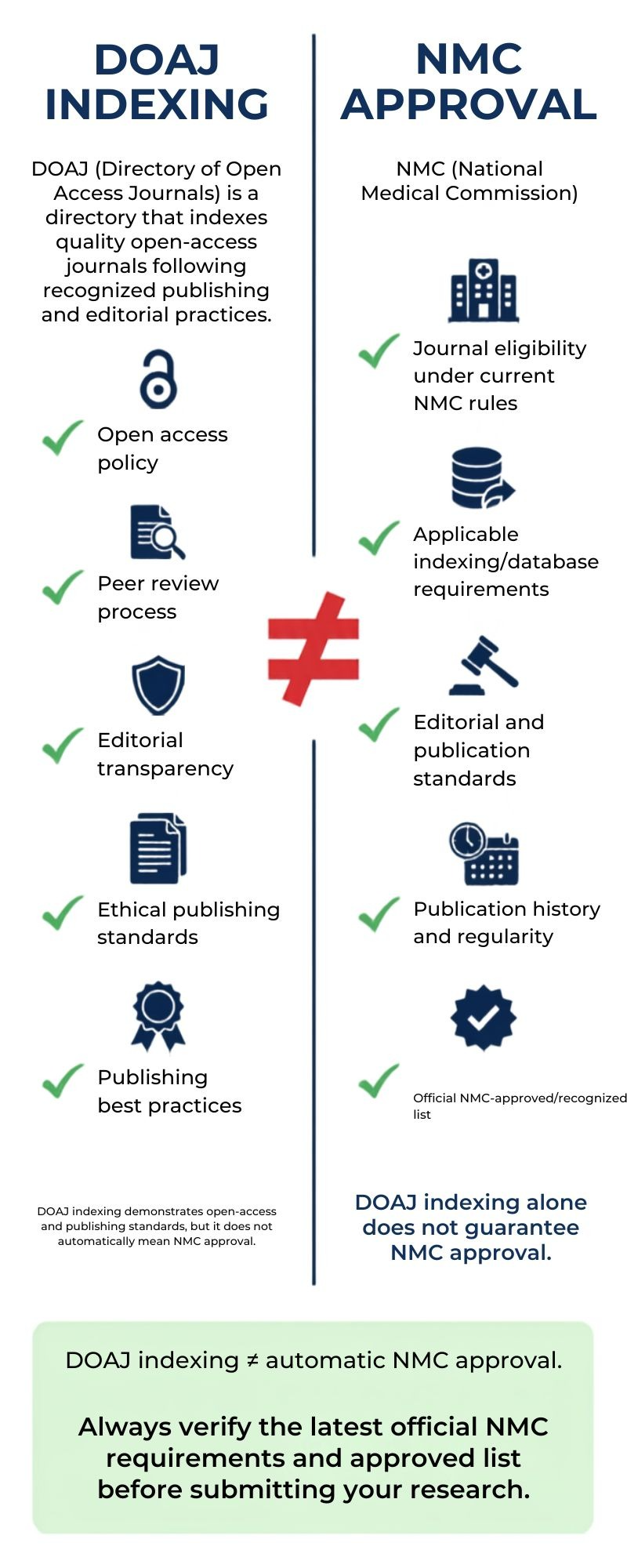
The distinction is critical in following the NMC guidelines with respect to publishing.
The information in the research highlights that it is a real problem because researchers could be misled to believe that database indexing is the whole criterion for inclusion.
Understanding NMC Journal Indexing
NMC journals Indexing is not an independent indexing process run by NMC itself.
Rather, it means the databases recommended by NMC, which could be relevant to the qualifying publications. In the case of the DOAJ database, this implies the researcher must confirm the listing of the journal in the DOAJ database itself and not merely its claim on the journal’s website.
This is crucial because the coverage of databases changes over time.
The research materials that you have provided bring to light the possibility of errors that may occur from depending on the information available online through the journal’s website.
A simple way to think about it:
Current NMC regulation → eligible publication → relevant database → current journal indexing → authorship and other requirements → documentation
Every step matters.
Why DOAJ Can Be a Useful Signal
DOAJ has its own quality and transparency requirements.
According to its current guidance, journals applying for inclusion need to provide clear information about:
- Aims and scope
- Editorial board
- Peer-review process
- Author instructions
- Licensing
- Copyright
- Author charges
- Publisher information
- ISSN
- Open-access policy
DOAJ also demands that the journals publish scholarly work and make their publications openly accessible immediately.
Thus, the journals indexed in DOAJ serve as a good starting point for finding open-access journals for researchers.
However, this should still be viewed as a verification point rather than an alternative way of promotion.
What Medical Faculty Should Check Before Submission
The safest approach is to check the journal before submitting your paper.
| What to check | Why it matters |
|---|---|
| Current NMC regulations | Rules can change, so use the current framework |
| Article type | Confirm that your research falls within the applicable publication definition |
| DOAJ listing | Verify the journal's current record in DOAJ |
| Journal scope | Your research should fit the journal’s subject area |
| Authorship | Check the applicable authorship requirement |
| Publication timing | Timing may affect eligibility |
| Peer-review process | Check that the journal clearly explains its review process |
| Publication charges | Confirm APCs and other fees before submission |
| Evidence | Keep the article, DOI, author details, publication date and indexing evidence |
This practical checking process is consistent with the research material's recommendation to verify the applicable requirement, database and journal and preserve evidence.
Common Mistakes to Avoid
Mistake 1: “The journal has a DOI, so it must qualify.”
A DOI identifies a scholarly publication. It does not prove NMC-qualifying indexing.
The research material specifically warns against treating a DOI, ISSN, Google Scholar presence or journal website as proof of NMC eligibility.
Mistake 2: “The journal website says DOAJ indexed.”
Don’t stop at this point.
Look up the journal in DOAJ and check if its existing information is consistent with your intended choice.
Mistake 3: “I have enough publications.”
Publication count is not the sole criterion for eligibility. Other factors could also be considered depending on the type of the publication, the author(s), etc.
Mistake 4: “An old NMC list is still valid.”
This can be quite dangerous. The regulation and coverage may have been altered and that is why it is advised to use the existing framework instead of using an out-of-date list.
How the NMC Guidelines for Medical Faculty Affect Journal Selection
The NMC guidelines for medical faculty should be considered before, not after, publication.
The 2025 regulations govern qualifications, experience in teaching, requirements regarding publications in research, and training among others for the purpose of appointment and promotion. The public notice by NMC in 2026 also bears evidence that these regulations provide for all requirements for appointment and promotion.
In other words, journal choice must be included as an integral component of academic planning.
A faculty member must first consider the following question prior to submission:
- What position or promotion stage am I applying for?
- Which current NMC requirements apply to me?
- Is my article type eligible?
- Is the journal currently indexed in the required database?
- Does my authorship position meet the applicable requirement?
- Have I saved evidence of the journal's indexing status?
This is much safer than choosing a journal simply because it advertises itself as “NMC approved.”
DOAJ Is Important, But It Is Not the Whole Story
The role of DOAJ becomes much clearer when we separate two ideas:
Database eligibility and faculty eligibility.
DOAJ can help satisfy the database-related part of the current framework when the journal is actually indexed there and the publication meets the applicable definition.
But the complete NMC publication requirements involve more than database indexing.
A better way to approach the process is:
Current NMC rule → eligible article type → verified DOAJ indexing → applicable authorship requirements → other faculty requirements → proper documentation
This approach also addresses the main challenge identified in your shared research material: do not assume that indexing alone guarantees promotion eligibility.
Final Takeaway
DOAJ has a significant place in the present-day NMC publication system, since it is explicitly mentioned among the databases relevant to research papers which can be considered for fulfilling requirements.
In addition to this, inclusion of the paper in DOAJ cannot be regarded as a sufficient basis for claiming its qualification in all cases of appointment/promotion criteria fulfillment.
For medical researchers, the safest approach is simple:
Refer to the present NMC guidelines. Determine the type of article. Search for the journal through DOAJ. Ensure authorship and any other requirements. Have evidence of everything.
These are supported by the research data that stresses the importance of the independent index validation, problems with DOI/ISSN assumption, risks of using outdated lists, and preservation of evidence of publication.
In summary, DOAJ can be an essential component of the publication verification process, but it is not intended to be the whole NMC eligibility test.
Frequently Asked Questions
Are DOAJ indexed journals accepted under current NMC publication requirements?
DOAJ is named in the 2025 NMC regulations, but the publication must also satisfy applicable article, authorship, faculty and promotion requirements.
Is a DOAJ indexed journal automatically an NMC approved journal?
No. DOAJ indexing solves only one of the database conditions. Other conditions set by NMC also need to be met.
How should medical professors confirm NMC journal indexing?
Refer to the latest regulations of the NMC, find the journal on the corresponding database, confirm its current status, and keep the proof of indexing.
Is DOAJ-indexed journal appropriate for all promotions to medical faculties?
No, not necessarily. It will depend on the criteria set for that faculty position, type of articles, timing and other parameters as per the present NMC guidelines.
Do the publication services guarantee NMC promotion through DOAJ journal?
No. The publication services will help you choose the journal and submit your article but eligibility for NMC promotion depends upon NMC requirements.
Mikky Publication Experts
Mikky Publication Editorial
Published August 21, 2026